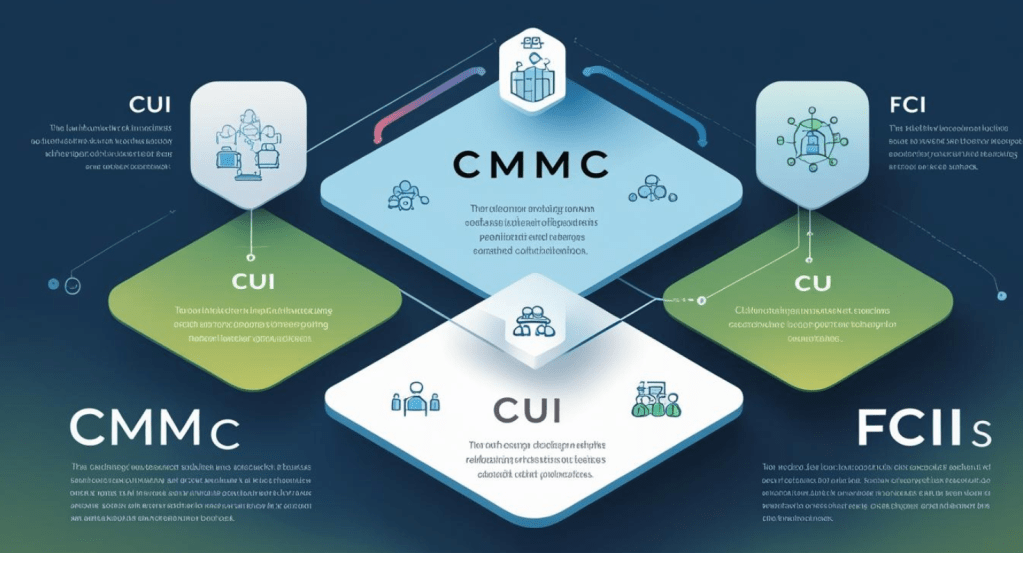
In response to developments in the cybersecurity landscape, the U.S. government has updated its policies for organizations that work with sensitive government information. It has established more defined expectations for safeguarding such data. Organizations involved in federal contracting—including at the subcontractor level—need to adopt advanced cybersecurity controls. They may also have to participate in third-party assessments. Additionally, they should thoroughly document compliance processes.
It’s important to understand which regulations apply to you, why they matter, and how to navigate them. This blog covers the Cybersecurity Maturity Model Certification (CMMC). It also discusses the types of government data (FCI and CUI). Additionally, it explains what’s required if your company holds government data without a federal contract.
What Is CMMC and Why Does It Exist?
CMMC (Cybersecurity Maturity Model Certification) is a framework established by the U.S. It is designed by the Department of Defense (DoD) to standardize cybersecurity. It also aims to strengthen cybersecurity across the Defense Industrial Base (DIB). This base consists of private sector companies that provide goods and services to the DoD.
Why was CMMC created?
In the past, contractors simply “self-attest” that they were following cybersecurity best practices. In light of observations regarding consistency in cybersecurity implementation across providers, the Department of Defense concluded that enhanced validation of compliance with established security standards was necessary.This process extends beyond simple self-attestation to ensure consistent protection of sensitive information.CMMC establishes mandatory certification for organizations involved in activities with higher risk exposure, requiring evidence—not just assertions—of strong cybersecurity practices.
FCI vs. CUI: What’s the Difference?
Not all government data is treated the same. Two key categories are Federal Contract Information (FCI) and Controlled Unclassified Information (CUI).
Federal Contract Information (FCI)
- Definition: Any information provided by or generated for the federal government under a contract, not meant for public release.
- Examples: Maintenance logs, contract details, statements of work.
- Protection Level: Basic cybersecurity controls—CMMC Level 1, based on FAR Clause 52.204-21.
- Assessment Type: Self- Assessment
Controlled Unclassified Information (CUI)
- Definition: Sensitive government information that requires safeguarding or dissemination controls under law, regulation, or government-wide policy. CUI must be specifically marked as such by the government; not all government data is CUI.
- Examples: Technical drawings, source code, personally identifiable information (PII) with a CUI marking, test results.
- Protection Level: Advanced controls—CMMC Level 2 or 3, typically requiring full compliance with NIST SP 800-171 (and selected additional controls for Level 3, from NIST SP 800-172).
- Assessment Type: Third-party
When Does CMMC Apply?
CMMC is required only if your company is a DoD contractor or subcontractor handling FCI or CUI.
If you process government employee data (like names or phone numbers) but are not under a federal contract that involves FCI or marked CUI, CMMC does not apply.
However, you are not off the hook for security and privacy laws:
- Privacy Act of 1974 and agency-specific privacy rules apply to government PII.
- State and international privacy laws (CCPA, GDPR) may apply, depending on the data and your location.
- Commercial contracts may require compliance with standards like ISO 27001, SOC 2, or the NIST Cybersecurity Framework (CSF).
Common Misunderstandings
- Not all government data is CUI. Only information specifically identified and marked as CUI by the federal government qualifies.
- CMMC is not a government-wide standard. It applies only to DoD contracts and subcontracts involving FCI or CUI.
- Privacy laws apply even without a federal contract. If you possess government employee PII, you must comply with applicable privacy regulations regardless of whether CMMC or NIST 800-171 applies.
CMMC is a critical evolution in federal cybersecurity, shifting from trust to verified compliance for DoD contractors. The types of data you handle—FCI, CUI, or just general government PII—determine which rules apply. These types of data influence how strict those controls must be. They also decide whether third-party assessment is required.
In cybersecurity, trust is good—but verified compliance is your new competitive edge.



 Infosec Journey
Leave a comment